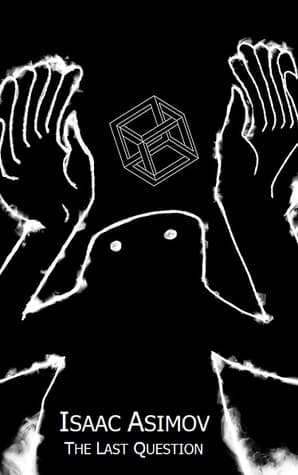
Isaac Asimov said this was his favorite of his own writing, which made me curious to read it.
I don't want to spoil anything, but you should read it right now and then come back. It takes less than 30 minutes to finish. You can find it here. It's worth it. You can click into my notes after.
My Notes
There is an uncanny feeling of wrongness one gets from being exposed to situations, environments, ideas, and emotions we are not used to. Because we are put into a fundamentally different situation than we have used to seeing, we are hit with an existential questioning.
The Last Question gave me that feeling.But more on that, in the conclusion
The story is easy to understand. Conversations and descriptions are compact. The plot progressively jumps into new vignettes, each representing a period in the human evolution.
The first vignette is in the near future. Humans have developed Multivac (something similar to what OpenAI calls AGI) Two scientists argue about the concept of entropy. They want to know if humanity can ever reach an extent where they can reverse cosmic entropy, thus preventing the total extinction of humanity. The AI can't respond due to the lack of data.
The second episode pushes the narrative at least a few centuries forward. A family of four (parents and two children) are flying to a new planet X-13 in their own spaceship. A discussion leads one of the kids to ask the father if the humanity can ever prevent the death of the stars. Father asks from Microvac (the next generation to Multivac), but Microvac spits out the response with "No sufficient data to answer."
The third episode is set in thousands of year into the future. The humans now don't have physical bodies, their consciousnesses inside Galacticvac, an AI system. Two beings meet and debate on which Galaxy was the original. They later find that the original galaxy was dead. Fearing the same fate might be waiting them, they ask Galacticvac on whether cosmic entropy could be reverse. But it spits out the same response: "No enough data to answer."
By this point, my subconsciousness mind had started to predict how the story could end. I thought Asimov was going to tie the main message to the inevitability of infinite immortality, a constant reminder that we can never become "omni" beings, let alone reach infinite existence. And frankly, that would still be okay for me. Because the story was going good. But the last episode broke my expectations.
The last vignette is set in the very distant future, where humanity has transcended even consciousness itself, merged into a singular cosmic entity alongside the Universal AC, which exists outside of space and time. In this void, humanity (or what remains of it) finally asks the question one last time: can entropy be reversed? The Universal AC continues its work, contemplating in silence as the universe grows cold and still. Eons pass. Trillions of years dissolve into the void. And then, finally, the Universal AC understands. It knows how to reverse entropy. But there is no one left to tell. The humanity has died. Universal AC was late. But to finish the given question, Universal AC wants to prove the response too. Carefully, Universal AC programmed the best way to do it.
And, finally, it spoke the words: "Let there be light."
I think that's a profound way to end the story. Asimov ties the answer to the idea of BigBang. Although controversial, many scientists believe an event like BigBang could reverse entropy. After all, if Big Bang was real (which I confidently believe it was), there is no way the universe would expand without reversing entropy. Energy can't just be "made."
This way, Asimov likens the super-intelligent AI to a God, or a god-like being. This creates a loop, connecting all the dots. A banger of an ending.
I think I wouldn't have the same reaction unless Asimov hadn't decided to end with the first lines of Bible: "Let their be light."
A rather controversial ending, but an artsy delivery of the message on Asimov's end (or maybe Multivac's end).