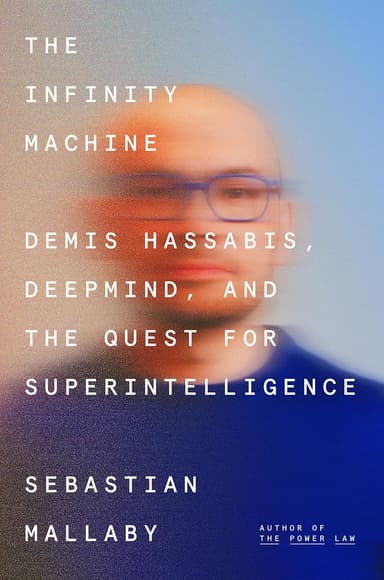
I'd already read The Coming Wave by Mustafa Suleyman, Demis Hassabis's co-founder at DeepMind. It left me a bit cold. Written for policy-makers, not builders. So I came into The Infinity Machine with modest expectations.
But Hassabis is a genuinely different kind of person. He became a chess master as a teenager. A 2300 Elo rating, while running a company and later becoming a Nobel-winning scientist, is just nuts.
After realizing that Chess offered him little meaning, he joined a local game development studio as a summer intern. It was there that he ran his earlier experiments with autonomous systems. Theme Park, which simulated how non-playable characters would respond to player-triggered events, was a success.
He then went back to study neuroscience at Cambridge, having turned down a million-dollar offer from Peter Thiel to skip university altogether. For someone aiming to build the AGI, understanding what intelligence actually was imperative in the journey ahead. That decision is the whole story of Demis. It's what sets him apart from nearly every other founder in the current AI race.
He founded DeepMind in 2010 with Shane Legg and Mustafa Suleyman out of a small office in London. The co-founders set out on a mission to build AGI scientifically, by understanding how intelligence works rather than just scaling compute.
Four years later, before DeepMind had a single commercial product, Google acquired it for roughly 500 million dollars. Demis and his team stayed in London.
Most CEOs just somehow stumbled into the AI race. Demis had chosen it from the beginning. The book makes that clear. Once we apply that context, Alphafold doesn’t exactly seem like a lucky breakthrough. You'd expect Demis's team to solve the protein folding problem eventually, one way or another. That first-principles discipline of Demis’s, which inevitably translates to the rest of the DeepMind team, makes their failure feel almost impossible.
But the book's actual argument is darker and more interesting than a success story. The race to AGI is a character test. Hassabis passes it better than anyone alive. And that might still not be enough.
AGI is coming. The people building it know it's dangerous. And the outcome depends almost entirely on the character of the small group steering it. Hassabis is the best-case scenario, a chess prodigy turned neuroscientist, turned the most influential AI researcher on the planet, someone who has thought seriously about existential risk since before it was fashionable.
The book is structured so that you trust him completely by the final chapter. Which is precisely what makes the Oppenheimer parallel at the end land so hard. You can be brilliant. You can be good. You can build the most consequential technology in human history for the right reasons. And still lose control of what the world does with it.
The book lingers at times, but it gives a solid understanding of what AGI is and how important it is for the builders of it to possess desirable character traits, free of arrogance and ephemeral wordly gains.
I knew about Demis before. But I didn’t know him up close. A solid 8.